
Damp in older properties
Your survey report might have indicated high moisture levels and damp in your property, or you may have noticed damp patches and a musty smell in your home. Understanding damp and its causes will help you decide on your next course of action.
Moisture in a property is normal
There will always be a certain level of moisture within the fabric of a building. Moisture level can vary on a day to day basis; it depends on variables such as air temperature and humidity that affect what’s called the ‘dewpoint’, (the point at which water vapour changes state from a gas to a liquid). Moisture is only referred to as ‘damp’ once it reaches a point where it can cause damage to the property or harm to the occupants.
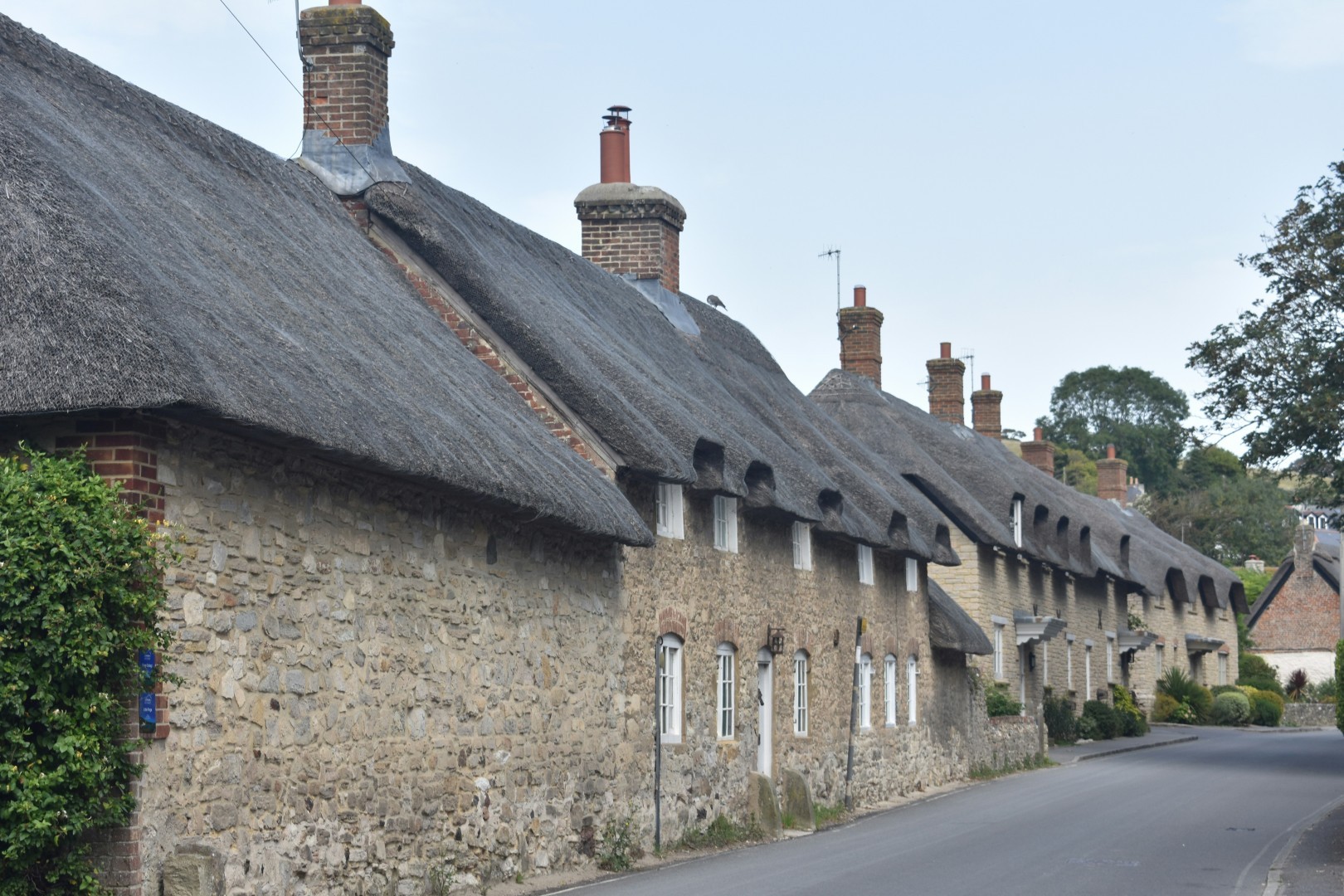
Traditional buildings in particular are expected to have some moisture present. This is not usually a failure of the building; older properties were designed with the acknowledgement that water would penetrate, and so were constructed with a design and materials that would allow moisture to evaporate easily. This contrasts with modern houses that are protected by damp proof courses and modern insulation; in these properties, water is not expected to enter.
Moisture readings are taken on a building survey as part of a comprehensive assessment of damp; the results are considered alongside the appearance, feel and smell in a property, and whether or not there are any signs, symptons or risk factors for damp present. Experienced surveyors understand the background levels of moisture that are expected within a period property, and can advise on whether the moisture present is normal or whether additional moisture is trapped and cannot evaporate quickly enough.
When moisture leads to damp
Period properties tend to develop damp when the equilibrium between water entering and evaporating is disrupted. Poor maintenance can allow excess water penetration, and modern lifestyle factors such as prolonged steamy showers, drying washing indoors and even cooking, can lead to condensation build-up inside. The most common cause of damp that our surveyors see in older houses is the inappropriate use of modern materials when additions and alterations have been made.
With older buildings, it’s all about managing them properly, and using the right materials so that the building fabric is able to regulate moisture on its own. The use of modern materials such as plastic membranes, gypsum plaster and cement-based mortar will interrupt the natural permeability of the property and restrict evaporation. The only way to bring that back is to reinstate those traditional materials and carry out repairs in the traditional way, such as repointing or replastering using lime-based mortar or plaster.
Repairs and alterations to fix damp issues in period properties
With a listed building, the reinstatement of traditional materials is often something that has to be achieved over a long time frame, replacing inappropriate materials when they reach the end of their natural lifespan, rather than trying to remove them prematurely, which can often end up damaging the historic building fabric.
The use of an injected damp proof system should be avoided as this will merely divert the damp to other areas, rather than addressing the underlying cause of the issue. Modern, non-breathable materials should also be avoided, because these will merely divert the damp to other areas, rather than addressing the underlying cause of the issue.
A Level 3 building survey will contain detailed advice on repairs that are required, along with recommendations on which materials and methods are appropriate according to the age of the property. Your surveyor will also be able to answer questions post-survey, and clarify anything you are unsure about.
Common causes of damp in older properties
The most common cause of damp in older properties is the inappropriate use of modern non-breathable materials. This can take many forms, from the installation of waterproof membranes, to the use of impermeable paints, cements and render. Other common causes include ineffective drainage, poor maintenance and even lifestyle factors.
Inappropriate paintwork
Silicone-based paint finishes can inhibit the natural evaporation of moisture from the surface of brickwork and can, in extreme cases, lead to damp conditions developing internally.
If damp conditions are identified internally, it is prudent to leave the painted finishes to weather and deteriorate naturally until such time as they can be removed and then restore the fair faced brick finishes. At this point, any redecoration should be undertaken using traditional limewash to maintain permeability of the masonry.
Waterproof membranes
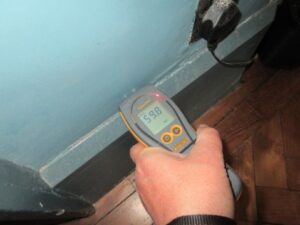
Using waterproof materials over a solid ground floor can trap water below the membrane, forcing it to escape via walls in the form of damp.
Here the floor was of modern solid concrete slab construction, and had a blue plastic damp proof membrane below the slab (visible at the left hand edge of the slab at the abutment with the skirting board). This floor construction would have replaced the original floor, which would most likely have comprised stone slabs laid directly upon that ground.
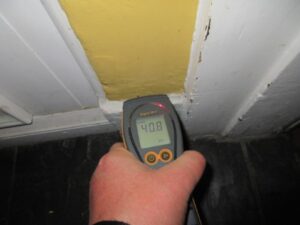
Elevated damp readings were noted to the walls. It is also possible that the dampness was caused by a build of hydrostatic pressure following the replacement of the original floor structure with the modern ground bearing solid floor slab and damp proof membrane. The solid floor slab will force ground moisture to the edges, where it meets a path of least resistance at the junction with the wall upstand around the room perimeter. When the slab was laid, it is unlikely that any damp proof membrane was correctly detailed across the junction given that there is no physical damp proof course to connect to, leaving an unsealed junction where moisture can penetrate. Over time, this has drawn moisture up the wall surface.
The issue of dampness in relation to hydrostatic pressure is complex, and remedial repairs cannot be designed or implemented without further destructive investigations.
In this case, we recommended that the wall plaster in the affected areas should be carefully removed, followed by replastering using traditional lime plaster to improve permeability and aid the natural evaporation of moisture from the wall. Given the age of the property and absence of any formal damp proof course, some degree of dampness must be accepted.
Tanking
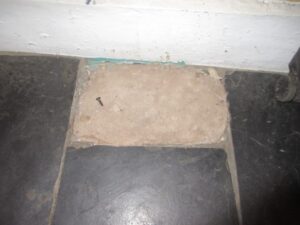
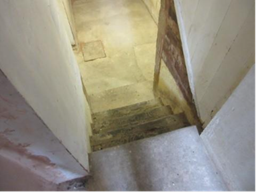
Cellars and basements are often tanked to address damp issues. However, such tanking measures are not recommended in historic or traditional properties because they seal water within the walls, typically causing moisture to be ‘pushed’ to other areas of the property.
It is therefore very important when buying a period property with a tanked cellar that your solicitor obtains relevant warranties, to protect you should problems arise as a result of the tanking.
Portland cement mortar
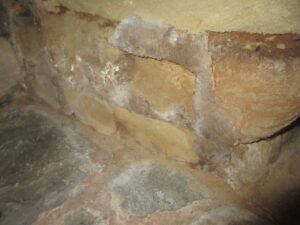
Modern cement mortars are not water permeable, and as such contribute to water getting trapped within the masonry instead of establishing an equilibrium between absorption and evaporation. Hairline cracks in the mortar can also allow water to seep into the building and masonry, where it will struggle to escape again.
Here, repointing works have been undertaken in the past using a modern Portland cement-based mortar, which has resulted in water retention in the stonework, causing it to deteriorate at an accelerated rate. Elevated damp readings to the stonework was noted at the time of our inspection, We would advise that the existing cement mortar is carefully raked out and the joints repointed using traditional lime mortar in line with our earlier guidance and advice.
Render
Cement or water-proof render can exacerbate damp in older properties by trapping moisture inside the building. In these cases, the render can be replaced with a water-permeable material such as lime render.
If this isn’t feasible, the situation can be improved by removing a small strip of render can be removed at floor level around the room perimeter and either grated or filled with lime concrete, to allow moisture to evaporate out of the building.
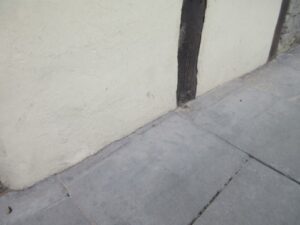
Here, render finishes extended fully to the external ground level. This can result in an increased risk of damp conditions developing internally because moisture is drawn up behind the render.
Rainwater goods
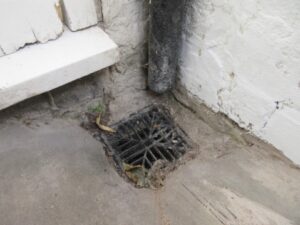
Water coming out of downpipes can splash and collect next to walls, where it could penetrate. In this case, extending the pipe fully into the mouth of the gulley would prevent any discharge of rainwater against the base wall.
Blocked drains can similarly result in water pooling at the base of walls, facilitating penetration. Blocked gutters commonly allow water to run down the walls of a house, increasing the amount of moisture ingress.
Single skin wall construction
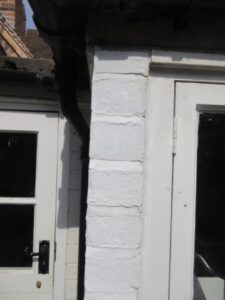
Slender single skin walls are common in older properties, but are no longer used and are not considered to be robust and suitable for habitable accommodation by modern standards. They are vulnerable to moisture penetration, as well as heat loss.
In this case we found elevated damp readings on the inside walls. Because the walls were slender brick construction measuring approximately 100mm in thickness, elevated damp readings in this location were to be expected.
Whilst it may be possible to mitigate some of the dampness in areas like these by replastering using traditional lime plaster to improve natural evaporation, a degree of dampness, particularly during the wet winter months, should be anticipated.
Poor maintenance and poor workmanship
Damage to roofs, chimneys and parapets can allow water in, as can a broken roof tile or defective flashing. Cracks and gaps in mortar and masonry can also provide entry routes for moisture.
Similarly, gaps left by poor workmanship allow moisture ingress into a building.
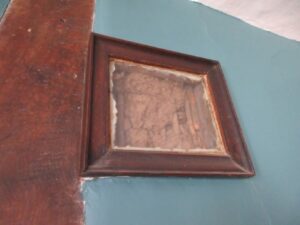
Wattle and daub, as seen here, is known for its ability to help to disperse damp. However, if it is not kept dry, the woven wattle panels can become affected by rot and the daub filler can crack and deteriorate.
Lifestyle factors and condensation
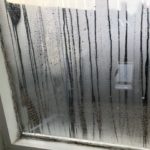
Condensation can result from modern lifestyles, with large amounts of steam produces from cooking and washing. Excessive insulation, and even installing double-glazing throughout an old property, can result in a build up of condensation.
Ventilation is critical for the proper dispersion of water vapour.
Next steps after finding damp
Where further investigation is needed, it should be compliant with JPS 2022 – Joint Position Statement 2022: Investigation of Moisture and its Effects on Traditional Buildings. It is important that any further investigation is undertaken on an unbiased and impartial basis and not simply for the purposes of obtaining a quotation. This inspection should be undertaken prior to Exchange of Contracts if you are planning to proceed with the purchase of the property.
Additional guidance and advice on the ongoing care, maintenance and repair of historic properties is provided by various Heritage Associations, notably Historic England and the Society for the Protection of Ancient Buildings (SPAB).
Or contact us for more information:
info@allcottassociates.co.uk | 0333 200 7198