
Buckinghamshire Listed Building Surveyors
Regulated by RICS
Instant Quote | NO OBLIGATION

Or Call 0333 200 7198
Our RICS surveyors have decades of experience in heritage property and Grade I and II listed homes.
Covering Milton Keynes, Buckingham, Aylesbury, High Wycombe, Marlow and surrounding areas, our Buckinghamshire team includes RICS Certified Historic Building Professionals, listed building experts and heritage specialists.
Buckinghamshire Building Surveyors
Listed building surveys in Buckinghamshire
Our local RICS Chartered surveyors live and work in the region, covering Milton Keynes, Buckingham, Aylesbury and the surrounding towns and villages. They have decades of experience of property in the area, and can provide expert advice and insight into period properties ranging from the Victorian era through to those built over half a millenium ago.
Our listed building surveys follow the most comprehensive, RICS Level 3 specifications. We ensure our reports are among the most detailed – and useful – on the market. Our surveyors take the time to thoroughly assess the property, looking at the construction type and materials used, and taking into account any later alterations and additions.
Their expert advice helps home buyers and vendors understand the current condition of the property, historic damage and defects and future repair and maintenance requirements. Our expertise in the field means we can provide detailed advice on the appropriate materials and methods to use for remedial works, along with estimated costs.
Everything from damp, to structural movement, to timber condition, will be considered and described. Our surveyors understand that looking after a Grade II or Grade I listed home can be complex at times, and use their knowledge to reassure, advise equip you to look after your property.


Nicholas Kelly FRICS, MCIfA, IHBC, RICS Certified Historic Building Professional
Our Listed Building Survey team is led by Nick Kelly FRICS. Nick lives in Buckinghamshire and has spent his career dedicated to delivering high quality building surveying, particularly in the field of heritage conservation.
With experience working for The National Trust, English Heritage and the Landmark Trust, Nick’s knowledge of period property, heritage construction types and listed building legislation is second to none.
At Allcotts, Nick has surveyed countless residential and commercial listed properties, including an 18th century farmhouse complete with its own stocks and the historic Avoncroft Museum.
Recent Buckinghamshire Listed Building Surveys
Large Buckingham farmhouse with retained original parts dating back to 1609
It was a Grade II listed building, with internal walls built using a combination of solid construction and historic timber frame with wattle and daub infill.
Wattle and daub
Wattle and daub infill may include animal hair as part of the construction. This poses a health and safety concern due to the potential presence of anthrax spores. These should present no risk if undisturbed. However, if refurbishment works are undertaken and the material is disturbed this could release harmful fibres in the air. Prior to any proposed works to the original timber structure the materials should be tested to ensure correct safety protocols in advance.

Three storey semi-detached Grade II listed house in Milton Keynes dated from 1675
This was a timber frame and solid masonry construction. The original building would have been of historic timber frame construction, but the front elevation appeared to have been reconstructed in approximately 1850.
Timber frame
Historic timber frame construction was widely used in a variety of forms from medieval times up to and including the 18th century. This form of construction utilises a structural skeleton of load-bearing hardwood timbers, commonly filled with non-structural materials such as bricks or lath and plaster. In this case, accecss to the original timber frame in the cellar revealed the use of non-structural brick infill.

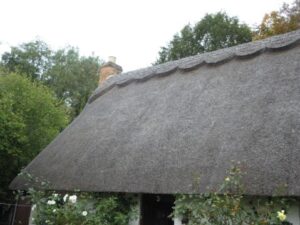
17th century thatched cottage in Great Horwood
This cottage dated back to the 17th century. It previously comprised four two-storey cottages, but had been converted into one single-storey home.
Thatch
Thatch is made up of the roof and the ridge. The ridge is the section of roof along the top and takes the brunt of the impact of the weather on the roof. Because of this, ridges need to be replaced every 10–20 years. Keeping the ridge in good condition protects the rest of the roof, so maintaining it is well worth the cost and effort.
Our Expert Surveying Approach
We are firm believers in providing a professional report that is informative and above all, useful. We write bespoke reports for every property, rather than relying on tablet software and standard phrasing. Crucially, we avoid caveating our statements, so that you receive an expert opinion on the condition of all aspects of your property.
Our reports are designed not to scaremonger; when taking on an older or larger property, it is expected that there will be some repair and maitnenance requirements and there is no need for this to block a sale. Our reports are meant as an advice booklet so that you understand the maintenance requirements and financial liabilities associated with the upkeep of the property.
Ultimately, the report will help you confirm whether the property is right for you.
If the property is in disrepair, we will provide a report detailing what needs to be done to bring it up to modern living standards, with the use of traditional materials and trades to preserve the fabric and nature of the building.
We work with a lot of contractors who specialise in these types of property and we can often provide recommendations if required.
Example reports

Or contact us for more information:
info@allcottassociates.co.uk | 0333 200 7198